

The Doctor’s Guide to Multivitamins for Women: Choosing for Bio-Viability in 2026
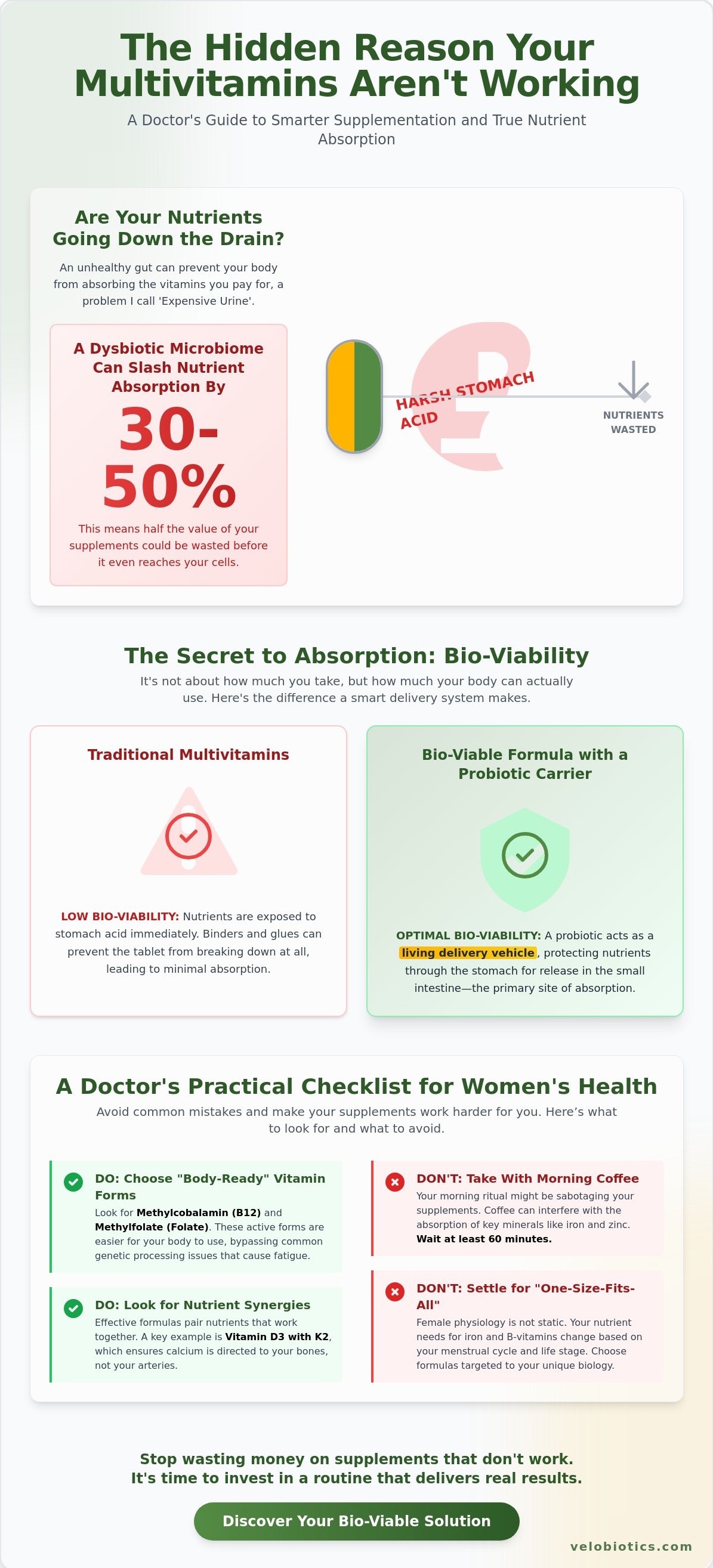
Did you know that a dysbiotic microbiome can slash your nutrient absorption by 30% to 50%? It is a startling figure that explains why so many women feel like they are flushing money down the drain. You have likely experienced the bloating that comes from cheap fillers or the frustration of seeing zero change in your energy levels after weeks of consistency. It is exhausting to play the guessing game with multivitamins for women, especially when you are trying to balance hormones or choose between prenatal and daily support.
I agree that the supplement industry often feels like a maze of vague promises and "expensive urine." You deserve a routine that actually works. In this guide, I will teach you how to identify formulas that prioritize bio-viability, ensuring that the active ingredients actually reach your bloodstream. We will break down the science of nutrient delivery, look at the latest 2026 regulatory shifts, and simplify your daily routine so you can finally feel the results you are paying for.
Key Takeaways
- Understand why stomach acid is the primary barrier to traditional supplement efficacy and how a probiotic "carrier" ensures nutrients actually reach your bloodstream.
- Learn how to select multivitamins for women based on a clinical life-stage framework, moving beyond the outdated "one-size-fits-all" approach to female health.
- Master the practical "do's and don'ts" of daily supplementation, including why your morning coffee might be sabotaging your nutrient absorption.
- Discover the dual-action benefits of a regimen that prioritizes bio-viability to improve hormonal balance and gut health simultaneously.
Beyond the Label: Why Your Multivitamin Needs to Do More in 2026
In 2026, the women's health and beauty supplements market is projected to reach $101.02 billion. Despite this massive growth, many women still rely on generic, one-size-fits-all formulas that treat every biological system as a carbon copy. This approach is clinically outdated. Before we look at how to optimize your intake, it's essential to understand the basics: What is a multivitamin? Traditionally, it's a blend of essential micronutrients designed to fill nutritional gaps. However, standard "gaps" don't account for the modern stressors, hormonal fluctuations, or the complex gut environment of the modern woman.
Your gut microbiome is the gatekeeper of your health. If you are struggling with dysbiosis, you might be losing 30% to 50% of the nutrients you consume. This is why "bio-viability" is the most important metric you've never heard of. It's not about the total milligrams listed on the back of the bottle; it's about the percentage of those ingredients that actually survive your stomach acid and enter your bloodstream to support your energy, skin, and hormonal balance. High doses don't matter if they never reach your cells.
To better understand how to differentiate between high-quality supplements and marketing hype, watch this helpful video:
The "Expensive Urine" Myth vs. Reality
Many of my patients ask why their urine turns bright yellow shortly after taking multivitamins for women. While some of this is just the natural excretion of excess B2, it's often a sign of a deeper efficacy gap. Many mass-produced tablets use heavy synthetic binders and glues. These materials are designed for shelf-life, not human digestion. Sometimes, these pills are so tightly packed they pass through your small intestine without ever breaking down. You're left with the "expensive urine" phenomenon because the delivery system failed. Your gut is the gatekeeper. If the tablet doesn't disintegrate at the right time, those nutrients are simply wasted.
Why Female Physiology Demands a Targeted Approach
Your body isn't a static environment. Your requirements for iron and B-vitamins shift dramatically based on your menstrual cycle and life stage. Most generic supplements ignore these nuances. They also often lack the necessary co-factors for absorption. For example, taking Vitamin D3 without K2 is a common clinical mistake; without K2, your body can't effectively direct that calcium to your bones. It's these synergies that determine whether a supplement actually improves your health or just sits in your system.
Practical Tip: Flip your bottle over and check the forms of the vitamins. You want to see "Methylcobalamin" for B12 and "Methylfolate" for Folate. These are the active, "body-ready" versions. Avoid synthetic Folic Acid or Cyanocobalamin, as many women have genetic variations that make these forms difficult to process, leading to the very fatigue you're trying to fix.
The Science of Bio-Viability: Why Probiotics are the Secret to Absorption
Most people view the stomach as a simple waiting room for digestion, but it's actually a harsh, acidic vat designed to break down organic matter. For traditional multivitamins for women, this environment is a graveyard. Gastric acid often degrades delicate vitamins and minerals before they ever reach the small intestine, which is the primary site for nutrient absorption. If your supplement can't survive this "gastric trek," its biological utility drops to near zero. This is where the clinical concept of a "probiotic carrier" changes the equation entirely.
A probiotic carrier acts as a living delivery vehicle. Certain strains of bacteria, particularly those in the Lactobacillus family, do more than just balance your gut; they are active metabolic factories. These specific microbes can actually synthesize B vitamins and improve the bioavailability of minerals like magnesium and zinc. To understand the baseline of what these nutrients should do for your body, you can refer to the NIH consumer guide to multivitamins. However, the secret to making those nutrients work lies in the health of your microbiome. Without a thriving gut environment, even the most expensive formula is just passing through.
By integrating probiotics directly into the multivitamin structure, we create a symbiotic relationship. The bacteria protect the nutrients, and the nutrients provide the fuel the bacteria need to colonize your intestinal wall. It's a foundational shift from simply "taking vitamins" to "optimizing a biological system."
Micro-Encapsulation: The Clinical Shield
Think of micro-encapsulation as a high-tech spacesuit for your nutrients. This proprietary technology seals active ingredients inside a microscopic, acid-resistant barrier. While standard tablets begin dissolving the moment they hit your stomach, micro-encapsulated formulas remains intact. This ensures that 100% of the payload is delivered exactly where it's needed: the lower GI tract. This level of protection is what separates a professional-grade supplement from a generic grocery store pill. If you want to ensure your routine is effective, you should explore advanced delivery systems that prioritize this level of survival.
Synergy in Action: Vitamins + 16 Strains
A resilient gut requires diversity, which is why a multi-strain approach is superior to single-strain products. Using a blend of 16 distinct probiotic strains creates a more robust ecosystem capable of handling various digestive challenges. When you pair this microbial diversity with collagen peptides, you address both internal absorption and structural health. The 16 Strains Probiotics Collagen Peptides formula is a prime example of this synergy, supporting the gut lining while simultaneously providing the building blocks for skin, hair, and nail health. It's about creating a comprehensive environment where multivitamins for women can finally perform at their peak clinical potential.
Matching Your Multivitamin to Your Life Stage: A Clinical Framework
Context is everything in clinical nutrition. A 25 year old woman focus on athletic performance has a completely different "biological job" than a 55 year old woman managing the physiological shifts of perimenopause. Generic multivitamins for women often ignore these nuances, offering a middle-of-the-road dosage that serves no one particularly well. When you choose a supplement, you must first identify if your body is in a state of "daily maintenance" or "targeted recovery." Maintenance is about filling the gaps in a healthy diet, while recovery is about providing a nutrient surplus to repair systems under significant stress, such as hormonal transitions or postpartum depletion.
To see how these requirements scale across different populations, the NIH Health Professional Fact Sheet on Multivitamins offers a deep dive into the evidence-based data used by clinicians. However, reading a label like a professional requires looking past the marketing. You should prioritize three specific criteria: the use of "active" methylated vitamin forms, the inclusion of a proven delivery technology, and the presence of co-factors that aid absorption. If a bottle doesn't specify how it survives your digestive enzymes, it's likely failing the bio-viability test.
Conception, Pregnancy, and Breastfeeding
During the reproductive years, your nutritional needs aren't just about you; they're about the massive metabolic demand of building and sustaining another human life. Folate is the star of the first trimester, but it's vital to use "Methylfolate" rather than synthetic folic acid, as many women have a genetic inability to convert the synthetic version. Breastfeeding is another high-demand state often overlooked. It's a period where maternal depletion is common because your body will prioritize the nutrient density of your milk over your own bone and brain health. Utilizing a targeted formula like Pregbiotics Essentials ensures you have the surplus required to support both yourself and your baby without hitting a "nutritional wall."
Daily Wellness and Hormonal Balance
For daily maintenance, the focus shifts to the gut-hormone axis. You have a specific collection of bacteria in your gut called the "estrobolome," which is responsible for metabolizing and circulating estrogen. If your gut is sluggish or imbalanced, your hormones will follow suit. This is why the best multivitamins for women now integrate probiotics to keep this internal machinery running smoothly. For those looking to support urinary tract resilience alongside their daily nutrition, combining probiotics with cranberry extract is a clinically sound strategy. You can find this specific synergy in Femina Probiotic Capsules with Cranberry Extract, which helps maintain a healthy internal environment while simplifying your daily routine. It's about working with your biology, not just throwing ingredients at it.
Top Picks from the Velobiotics Women’s Collection
Most retail websites present you with a wall of 50 different bottles and expect you to play doctor. I find that approach clinically irresponsible. When I developed this collection, I wanted to remove the guesswork. This 11-product suite is built on the principle that your multivitamins for women must be as specialized as your life stage. Every formula here uses our proprietary delivery technology to ensure that the active ingredients actually survive the gastric trek we discussed earlier. By focusing on bio-viability, we bridge the gap between what you swallow and what your cells actually use.
The Daily All-Rounder: Her-Biotics
The Her-Biotics Probiotics Original Multivitamin is what I consider the clinical foundation for daily wellness. This 60-capsule formula is unique because it doesn't just list ingredients; it includes the probiotics directly in the capsule to act as a carrier. It is the best choice for women who feel stuck in a cycle of low energy and digestive discomfort. By stabilizing the gut environment first, we allow the vitamins to actually enter the bloodstream. It is a one-step solution for total-body maintenance, designed to simplify your routine without sacrificing potency.
Specialized Support: From Conception to Intimate Health
Your biological needs are not static. For those in the motherhood journey, the Pregbiotics range provides the specific methylated nutrients required for fetal development and maternal recovery. We also recognize that health extends beyond just what you swallow. Intimate wellness and pH balance are critical components of female well-being. Using Femina Cookie Fresh alongside your daily routine helps maintain a healthy vaginal microbiome through direct boric acid support. For women focused on metabolic efficiency and digestive comfort, the GutSlim Probiotics Tummy Toner provides targeted support to reduce bloating and optimize how your body utilizes fuel. You can learn more about our clinical approach to find the formula that matches your specific health goals.
How to Start Your New Regimen: A Doctor’s Practical Advice
Most generic advice suggests taking your supplement "whenever you remember." Clinically speaking, this is a missed opportunity. Your gut operates on a circadian rhythm, and its ability to process nutrients fluctuates throughout the day. For multivitamins for women, I recommend taking your dose in the morning with your first meal. This provides your body with the B-vitamins needed for daytime energy metabolism while the presence of dietary fats aids the absorption of fat-soluble vitamins like D3 and K2. However, there is one major morning habit that can sabotage your progress: your coffee.
I advise waiting at least 30 to 60 minutes after your morning cup of joe before taking your supplement. The caffeine and tannins found in coffee can act as inhibitors, binding to minerals like calcium and iron and preventing them from crossing the intestinal wall. By giving your system a small window of time to clear these compounds, you ensure that the bio-viability of your formula isn't compromised by your caffeine fix. Within the first 30 days of a high-viability regimen, you should monitor three key metrics: your digestive regularity, your mid-afternoon energy levels, and your skin's natural "glow." Because we prioritize the probiotic carrier system, improved gut comfort is often the very first sign that the formula is working.
Building the Habit
Consistency is the engine of biological change. To make your new routine stick, I suggest pairing your pill with a "daily trigger." This could be your first glass of water or the moment you sit down for breakfast. If you happen to miss a day, don't make the mistake of "doubling up" the following morning. Your body has a limited capacity for nutrient uptake at any single moment, and excess will simply be excreted. Instead, just resume your normal dose. Remember the "3-month rule": while you may feel better within weeks, it takes roughly 90 days for your red blood cells to turn over and for the full structural benefits of consistent supplementation to manifest in your tissues.
Your Next Steps to Better Health
In a world of "more is better" marketing, I urge you to choose quality and delivery over sheer milligram count. A supplement is only as good as its ability to reach your bloodstream. If you are ready to move away from generic fillers and embrace a clinically backed approach to wellness, you can browse the full multivitamins for women collection here. My goal is to provide you with the tools to take control of your biological narrative. If you want to understand the research and passion behind our delivery technology, you can read more about the Velobiotics story and how we are solving the absorption crisis in modern nutrition.
Elevate Your Health with Clinical Precision
Choosing the right supplements isn't just about reading a label; it's about understanding how your body actually processes those nutrients. We've explored how a healthy gut microbiome acts as the gatekeeper for absorption and why your biological "job" dictates your nutritional requirements. By prioritizing bio-viability through our proprietary micro-encapsulation technology, you ensure that every capsule survives the harsh environment of the stomach to deliver its payload where it matters most.
Our formulas are meticulously designed by medical doctors to bridge the gap between complex science and your daily routine. By utilizing a 16-strain probiotic delivery system, we transform standard multivitamins for women into a high-performance wellness tool. It's time to stop settling for "expensive urine" and start investing in a regimen that respects your unique physiology. Clinical efficacy is not a luxury; it's the baseline for your well-being.
I invite you to Shop the Doctor-Formulated Women’s Multivitamin Collection today to experience the difference that clinical-grade delivery makes. You have the power to optimize your energy, balance your hormones, and support your long-term health with every deliberate choice you make. I'm here to ensure those choices lead to tangible results.
Frequently Asked Questions
Do women really need a different multivitamin than men?
Yes, because female physiology has unique requirements for iron, folate, and calcium that differ significantly from male biological needs. Women experience monthly iron loss through menstruation and require specific ratios of bone supporting nutrients like Vitamin K2 and D3 to maintain density. Men's formulas often lack these specific concentrations or include higher levels of zinc that aren't always optimal for the female hormonal cycle.
Can I take a multivitamin and a probiotic at the same time?
You absolutely can, and it's actually clinically beneficial to do so. Probiotics act as a biological delivery system that stabilizes the gut environment, making it easier for your body to absorb the micronutrients in your multivitamin. Choosing a formula where the probiotics are already integrated into the multivitamin capsule ensures that the bacteria and nutrients reach the small intestine together for maximum synergy.
How long does it take to see results from a new multivitamin?
You should expect a 90 day window for full physiological integration, though digestive improvements often appear within the first week. While energy levels might stabilize within 30 days as your B vitamin levels normalize, structural changes in your skin, hair, and nails rely on the lifecycle of your cells. Consistency is the primary driver here; your body needs a steady supply of nutrients to repair and rebuild tissues effectively.
Should I take my multivitamin on an empty stomach or with food?
Always take your multivitamin with a meal to maximize the absorption of fat soluble vitamins like A, D, E, and K. These specific nutrients require dietary fats to be transported across the intestinal lining. Taking supplements on an empty stomach can also lead to nausea or gastric irritation, especially if the formula contains minerals like zinc or iron in non chelated forms.
What is the difference between Folate and Folic Acid in women’s vitamins?
Folate is the natural, bioactive form of Vitamin B9, while folic acid is a synthetic version that your body must convert before use. Many women possess a genetic variation that makes this conversion inefficient. When choosing multivitamins for women, always look for "5-MTHF" or "Methylfolate" on the label. These methylated forms are "body ready," ensuring that your nervous system and cellular repair processes get the support they need without metabolic bottlenecks.
Are there any side effects to taking high-potency probiotics in a multivitamin?
Some women experience mild bloating or changes in bowel habits during the first three to five days of use. This is a normal physiological response known as "microbiome shifting" as the new, beneficial bacteria colonize your gut. These symptoms are temporary and typically resolve quickly as your internal ecosystem stabilizes. If discomfort persists, it's a sign that your gut was significantly imbalanced prior to starting the regimen.
Can a multivitamin help with hormonal acne or skin health?
Yes, specifically by supporting the "estrobolome," which is the group of gut bacteria that helps regulate your estrogen levels. When your gut is healthy and your nutrient levels are optimized, your body can more effectively clear excess hormones that contribute to skin flare ups. Quality multivitamins for women that include Vitamin A and Zinc are particularly effective, as these are critical for cellular turnover and reducing the inflammatory response in your pores.
Do I still need a multivitamin if I eat a balanced, plant-based diet?
Even with a perfect plant based diet, modern soil depletion and food processing often leave nutritional gaps in Vitamin B12, Iron, and Vitamin D3. Plant based sources of iron are also less bioavailable than animal sources, meaning your body has to work harder to extract what it needs. A high viability multivitamin acts as an essential insurance policy, ensuring your micronutrient levels remain optimal regardless of seasonal variations in your food supply.

Disclaimer
Information and statements regarding dietary supplements/products have not been evaluated by the Food and Drug Administration, MCC/SAHPRA, MHRA, TGA or any other drug regulatory authority and are not intended to diagnose, treat, cure, or prevent any disease. Information on this website is provided for informational purposes only and is a result of years of practice and experience by the author. This information is not intended as a substitute for the advice provided by your physician or other healthcare professional or any information contained on or in any product label or packaging. Do not use the information on this website for diagnosing or treating a health problem or disease, or prescribing medication or other treatment. Always speak with your physician or other healthcare professional before taking any medication or nutritional, herbal, or homeopathic supplement, or using any treatment for a health problem. If you have or suspect that you have a medical problem, contact your healthcare provider promptly. Do not disregard professional medical advice or delay in seeking professional advice because of something you have read on this website.