

Does Yogurt Help Heartburn? A Doctor’s Myth-Busting Guide to Cooling the Fire
That cooling cup of Greek yogurt you're reaching for to douse the fire in your chest might actually be fueling the flames instead of putting them out. If you've ever wondered, does yogurt help heartburn, you aren't alone in your confusion. While 60 million Americans experience acid reflux at least once a month according to data from the American College of Gastroenterology, the dietary advice they receive is often contradictory. You've likely been told that dairy is a natural antacid, yet you still find yourself clutching your chest after a supposedly safe snack.
It's exhausting to live in fear of your next meal, but I'm here to bridge the gap between kitchen myths and clinical science. Today, I'll reveal the medical reality behind using yogurt for reflux and teach you how to select gut health strategies that don't just feel good for a second, but actually survive the harsh environment of your stomach acid. We'll explore the specific fermentation markers to look for and discuss how our Velobiotics technology ensures beneficial bacteria reach your gut alive, offering 1000x more delivery than standard probiotic supplements to provide long term relief.
Key Takeaways
- Understand the "one-way trapdoor" mechanism of your esophagus to see why simply cooling the fire isn't enough for long-term relief.
- Get the definitive medical answer to does yogurt help heartburn by learning how to navigate the pH scale and avoid hidden "fat traps" in the dairy aisle.
- Implement the "Ginger Hack" and master the science of timing to ensure your snacks support your digestion instead of triggering a midnight acid spike.
- Uncover the medical reality of the "Probiotic Gap" and why most beneficial bacteria in your yogurt are destroyed before they can ever reach your gut.
- Learn how to choose advanced strategies that ensure your gut-health microbes actually survive gastric acid to flourish where they are needed most.
The 'Fire' in Your Chest: Why Yogurt is the First Thing We Grab
We've all been there. It's 11:00 PM, and that spicy taco dinner is staging a painful protest in your chest. You're standing in the kitchen, light from the open fridge hitting your face, reaching for the tub of Greek yogurt. As a doctor and the founder of Velobiotics, I see this "fridge pharmacy" behavior every day. We instinctively seek out something cold and creamy to douse the flames. It feels like a fire, but biologically, it's a chemical spill. I often tell my patients to look at their fridge as a temporary pharmacy, but only if they understand what they're actually treating.
What Exactly is Heartburn?
Heartburn happens when your stomach's gastric acid, which typically maintains a harsh pH of 1.5 to 3.5, splashes back into your esophagus. This tube isn't built to handle such high acidity. When we ask What is heartburn?, we're looking at a chemical irritation of the mucosal lining that feels like a literal burn. While occasional discomfort affects about 60 million Americans at least once a month, frequent episodes might indicate Gastroesophageal Reflux Disease (GERD), a chronic condition affecting 20% of the population. Acid reflux is the mechanical failure of the LES valve. This Lower Esophageal Sphincter (LES) acts like a one-way trapdoor; when it weakens or relaxes inappropriately, the acid escapes upward.
The Psychology of the Fridge Raid
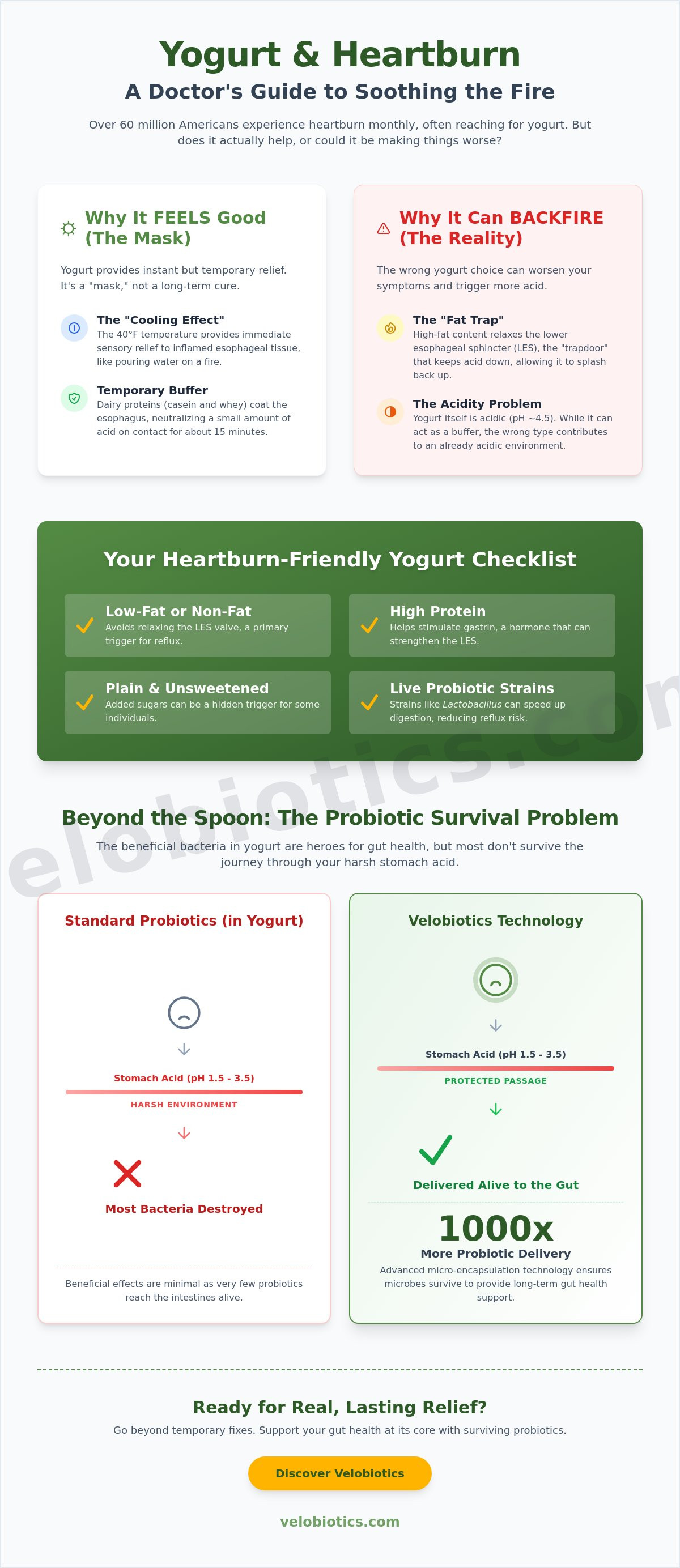
Why do we crave yogurt specifically when the fire starts? It's the "Cooling Effect" myth. The 40-degree temperature of the yogurt provides instant sensory relief to the inflamed tissue. It feels like pouring water on a campfire. Many patients ask, does yogurt help heartburn long-term, or is it just a temporary fix? The answer lies in the dairy protein. Casein and whey act as a temporary buffer, coating the esophageal wall and neutralizing a small amount of acid on contact.
You need to understand the difference between a "fix" and a "mask." While yogurt might soothe the sensation for 15 minutes, it doesn't repair the LES or stop the root cause of acid production. In fact, full-fat yogurts can actually trigger more acid in some individuals. When you're looking for real digestive support, you need solutions that address the microbiome and gastric environment. Our Velo16 probiotic digestive capsules are designed with this systemic health in mind, ensuring beneficial bacteria reach your gut alive to support overall digestion rather than just masking a symptom for a few minutes.
The Science of Soothing: How Yogurt Interacts with Stomach Acid
When patients ask me, "does yogurt help heartburn?" they're often looking for a simple yes or no. The reality is more interesting. While yogurt sits at a pH of approximately 4.5, making it technically acidic, it acts as a powerful "buffer" once it enters your system. In the stomach, where pH levels typically hover between 1.5 and 3.5, the introduction of yogurt helps raise the overall pH, neutralizing the harsh environment and providing that immediate, cooling relief you feel in your chest.
Beyond the immediate chill, yogurt influences how your stomach moves. This process, known as gastric motility, is the secret to long-term relief. When food sits in your stomach for too long, it creates upward pressure on the esophageal valve. Specific strains of Lactobacillus found in high-quality yogurt help speed up this transit time. The Science of Soothing suggests that functional foods can normalize these digestive rhythms, ensuring your dinner moves down rather than pushing back up. It's a simple mechanical solution: faster digestion equals less reflux.
However, the protein-to-fat ratio is where many people get it wrong. Fat is a known trigger that relaxes the lower esophageal sphincter and slows down digestion. To make sure your yogurt choice doesn't backfire, you must prioritize low-fat or non-fat versions. High protein content is your friend here, as it can actually help stimulate the hormone gastrin, which increases the tone of that vital esophageal valve.
Is Yogurt Acidic or Alkaline?
It's a common misconception that all acidic-tasting foods create more acid. While yogurt is slightly acidic on the scale, its high calcium content is a game changer. Calcium is essential for muscle contraction, and that includes the muscle responsible for keeping your stomach closed. Some fermented dairy products even have an alkalizing effect after they're metabolized, helping balance your internal chemistry. If you're struggling with frequent "fire" in your throat, reach your gut alive with a targeted approach to microbiome health.
Probiotics as the 'Gut Police'
I like to think of probiotics as the "gut police" that manage gas and bloating. Excess gas acts like a balloon inflating in your abdomen, forcing acid into the esophagus. By reducing this pressure, probiotics tackle the root cause of the burn. The problem is the "Survival Challenge." Most bacteria in standard yogurt are destroyed by stomach acid before they ever reach the lower gut. This is why a clinical approach to delivery is necessary. You can read more about this mechanism in our guide on Probiotics for Gastric Reflux, where we explain how our Velobiotics™ technology provides 1000x more delivery than standard brands.
Myth-Busting the Dairy Aisle: Not All Yogurts Are Heartburn-Friendly
Walking down the dairy aisle feels like navigating a minefield when your chest is on fire. You might ask, does yogurt help heartburn or just add fuel to the flames? The clinical reality is that the wrong choice can trigger a reflux episode that lasts for hours. Most people grab a tub based on the fruit pictured on the label, but as a doctor, I look at the molecular impact on your Lower Esophageal Sphincter (LES).
Fat is a slow mover. When you consume full-fat dairy, your body releases cholecystokinin, a hormone that tells your LES to relax. This effectively opens the door for gastric acid to climb back up your esophagus. High-fat yogurts often contain 8 to 10 grams of fat per serving, which can delay gastric emptying by up to 45 minutes. This keeps acid in your stomach longer, increasing the internal pressure that forces liquid upward. If you want to use dairy as a cooling agent, you must prioritize low-fat or non-fat options to keep that LES valve tightly shut.
Sugar creates a secondary "gas trap" in your gut. Flavored yogurts often pack 20 grams of sugar or more. These simple carbohydrates ferment rapidly in the digestive tract, producing carbon dioxide gas. This gas increases intra-abdominal pressure, a leading cause of the physical "push" behind acid reflux. To ensure your microbiome actually supports your recovery, look for the "Live and Active Cultures" seal. This certification ensures at least 100 million cultures per gram at the time of manufacture. Without these viable microbes, you aren't getting the motility benefits required to move food through your system efficiently.
The Best and Worst Yogurt Types
Non-fat Greek yogurt is the gold standard for reflux sufferers. It provides roughly 15 to 20 grams of protein per serving, which actually helps strengthen the LES. In contrast, full-fat "dessert" yogurts are essentially liquid triggers. Kefir is another excellent clinical choice. Because it is 99 percent lactose-free and contains 12 to 30 different bacterial strains, it improves gastric motility faster than standard yogurt. If you prefer plant-based options, almond yogurt is naturally alkaline, but avoid coconut-based versions. Coconut yogurt can contain up to 15 grams of saturated fat per cup, which is a recipe for a midnight heartburn disaster.
Hidden Triggers in Your Bowl
- The Flavor Trap: Avoid peppermint, chocolate, or citrus-flavored yogurts. These specific ingredients are known irritants that relax the esophageal lining.
- The Syrup Factor: "Fruit on the bottom" usually means high fructose corn syrup. This highly processed sugar is a primary fuel source for the "bad" bacteria that cause bloating and gas.
- The Additive Issue: Thickening agents like carrageenan can cause gut inflammation in 15 percent of the population, potentially worsening digestive discomfort.
For those who need more consistent support than a snack can provide, professional-grade supplements like Velo16 Probiotic Digestive Capsules ensure that beneficial bacteria actually reach your gut alive to balance your microbiome. Remember this rule of thumb for your next grocery trip:
A Doctor’s Prescription for Relief: Practical Ways to Use Yogurt
If you are asking, does yogurt help heartburn, I want you to think of it as a biological tool rather than a quick fix. In my clinical experience, the efficacy of yogurt depends entirely on how and when you consume it. It isn't just about the probiotics; it's about managing the mechanics of your digestion. If you eat a large bowl of yogurt and immediately lie down on the sofa, gravity will work against you, allowing gastric acid to slip past the esophageal gatekeeper regardless of how soothing the yogurt feels.
Timing is your first priority. I advise my patients to follow the three-hour rule: never consume yogurt, or any food, within 180 minutes of bedtime. When you lie flat, you lose the gravitational advantage that keeps stomach contents down. Additionally, you must practice strict portion control. I recommend a maximum of 125ml per serving. When you overfill your stomach, the sheer volume triggers the lower esophageal sphincter (LES) to stretch and open, which is exactly what we want to avoid during a flare-up.
Before committing to a full serving, perform the 'Yogurt Test.' Consume just two tablespoons of low-fat, plain Greek yogurt and wait 20 minutes. If your symptoms don't intensify, your body is likely responding well to the alkaline nature of the dairy. To boost the effect, try the 'Ginger Hack.' Freshly grated ginger contains gingerols, which are potent anti-inflammatory compounds. Adding a quarter-teaspoon to your yogurt creates a dual-action cooling effect on the esophageal lining.
The Ultimate Heartburn-Soothing Bowl
When you need a functional snack that supports your microbiome without triggering reflux, follow this clinical recipe. Use a base of low-fat Greek yogurt, mix in a dash of freshly grated ginger, and top it with half a sliced banana. Bananas are naturally alkaline, helping to neutralize excess acid. Don't add honey or agave during an active flare-up. These sugars can ferment in the digestive tract, creating gas that increases internal pressure and forces acid upward.
Eat this bowl slowly. Fast eating leads to aerophagia, or the swallowing of air. This trapped air increases gastric distention, which is a primary trigger for the LES to relax. Take small bites and chew thoroughly to ensure your saliva begins the enzymatic breakdown of the food before it even reaches your stomach.
When Yogurt Isn't Enough
While yogurt provides temporary relief, it won't fix a chronic microbiome imbalance or a structural issue. You should consult a physician immediately if you experience 'Red Flag' symptoms, such as an unexplained weight loss of 10% or more, difficulty swallowing (dysphagia), or persistent chest pain. These signals suggest that your condition requires more than dietary adjustments.
For long-term management, you need to bridge the gap between temporary relief and systemic health. This involves high-potency Probiotics for Digestive Health that actually reach the gut alive. Unlike standard yogurt cultures that are often destroyed by stomach acid, our micro-encapsulation technology ensures 1000x more delivery of beneficial bacteria to your microbiome. If you want to move beyond managing symptoms and start supporting your gut’s natural defenses, explore our Velo16 clinical-grade digestive support.
Beyond the Spoon: Why 'Surviving' Probiotics Are the Real Heroes
When people ask does yogurt help heartburn, they're often looking for a quick fix for a deep-rooted issue. While a cold spoonful provides temporary cooling, the idea that yogurt is a complete probiotic solution is the number one misconception I encounter in my practice. You aren't just eating for flavor; you're trying to fix a biological imbalance. However, a massive "Probiotic Gap" exists between the container and your gut. Clinical research shows that up to 99% of the live cultures found in standard yogurt are obliterated by the same gastric acid that's currently causing your chest to burn. If the bacteria don't survive the stomach, they can't help your microbiome.
This is where clinical technology changes the game. We developed Velobiotics™ micro-encapsulation to act as a protective shield for these delicate microorganisms. This patented process ensures 1000x more delivery of live, active bacteria to your intestinal tract compared to non-encapsulated sources. To truly address the root of digestive discomfort, you need a delivery system that doesn't surrender to stomach acid. Our Velo16 Probiotic Digestive Capsules provide the precise, high-potency support that a simple snack simply cannot match. It's the difference between sending a scout and sending an army.
The Science of Survival
Our micro-encapsulation technology wraps each bacterium in a protective layer that only breaks down once it reaches the alkaline environment of the lower gut. This isn't just about high CFU counts; it's about survival. By bypassing the gastric "fire," our 16 specific strains arrive ready to colonize and rebalance your system. These strains were selected for their diverse roles in supporting digestion and strengthening the gut barrier, ensuring your internal ecosystem is resilient against future flare-ups. Reaching the lower gut alive is the only way to truly rebalance the microbiome.
Taking Control of Your Gut Health
I want you to stop being reactive and start being proactive. Instead of waiting for the pain to reach for a temporary fix, build a 2026-ready routine that prioritizes long-term stability. This means consistent, daily probiotic supplementation that actually reaches its destination. As the founder of Velobiotics, I've seen how science-backed delivery changes lives. You don't have to live with the burn. By shifting your focus from "cooling the fire" to "rebuilding the foundation," you can reclaim your digestive freedom. Your gut deserves more than a spoonful of hope; it deserves science that survives.
Master Your Gut Health Beyond the Spoon
Understanding does yogurt help heartburn requires looking past the immediate cooling sensation on your tongue. While a few spoonfuls of low-fat Greek yogurt can temporarily buffer stomach acid, it's often a short-term fix for a deeper microbiome imbalance. We've explored how high-sugar varieties can actually fuel the fire, and why most standard probiotics in the dairy aisle fail to survive the harsh trek through your stomach's acidic environment. True digestive comfort isn't about what you swallow; it's about what survives.
Real relief comes from ensuring beneficial bacteria actually reach their destination alive. I founded Velobiotics to solve this exact problem using patented micro-encapsulation technology. This clinical innovation provides 1000x better delivery than standard supplements, protecting 16 clinically studied probiotic strains from gastric acid. It's a scientific approach to gut health that moves beyond the refrigerator shelf to provide lasting support. You don't have to settle for temporary fixes when you can choose a doctor-led solution designed for maximum potency.
Stop the burn at the source, explore Velo16 Probiotics with 1000x better delivery.
Take the next step toward a balanced gut and enjoy the peace of mind that comes with science-backed wellness.
Frequently Asked Questions About Yogurt and Heartburn
Is Greek yogurt better than regular yogurt for heartburn?
Low-fat Greek yogurt is generally superior because its intensive straining process removes more liquid whey, resulting in a thicker consistency that coats the esophageal lining effectively. While regular yogurt contains about 5 to 9 grams of protein per serving, Greek yogurt offers 12 to 20 grams. This higher protein content stimulates gastrin, a hormone that increases the pressure of your lower esophageal sphincter, keeping it tightly closed against rising acid. Stick to 0% or 2% fat versions to avoid triggering reflux.
Can yogurt make acid reflux worse for some people?
High-fat or heavily sweetened yogurts can definitely trigger reflux in approximately 20 percent of individuals with GERD. Full-fat dairy slows down gastric emptying, which means food sits in your stomach longer and creates upward pressure. Additionally, some yogurt has a pH lower than 4.5, making it quite acidic and potentially irritating to an already inflamed esophagus. If you notice a burning sensation after eating, you're likely reacting to the high sugar content or specific thickeners like carrageenan.
How much yogurt should I eat to stop heartburn?
Consuming a small portion of about 4 to 6 ounces of low-fat yogurt can provide immediate relief by neutralizing active stomach acid. When considering if does yogurt help heartburn, it's important to remember that it's a temporary buffer rather than a permanent cure. I recommend eating it slowly. A 2017 study in the Journal of Dairy Science suggests that the calcium and protein in dairy can temporarily increase the pH of your stomach contents, providing that desired cooling sensation.
Does frozen yogurt work the same way for reflux?
Frozen yogurt rarely provides the same benefits because it's often loaded with 20 or more grams of sugar per serving. High sugar intake can cause the stomach to produce more acid and may relax the lower esophageal sphincter. Most commercial frozen yogurts also lack the high CFU counts found in fresh varieties. For your microbiome to flourish, you need live bacteria that can survive the journey to your gut, which is difficult for frozen products to guarantee.
Can I eat yogurt if I have a dairy sensitivity and heartburn?
You should opt for plant-based alternatives like almond or coconut yogurt if you have a confirmed lactose sensitivity. About 65 percent of the global population has a reduced ability to digest lactose after infancy. If you choose dairy, look for "lactose-free" labels. These options still provide a soothing texture without the fermentation in the gut that leads to bloating and increased abdominal pressure, which are major contributors to the upward flow of gastric acid.
What is the best time of day to eat yogurt for digestion?
Eating yogurt about 30 minutes before a meal or as a mid-morning snack is ideal for digestive health. This timing allows the probiotics to interact with your microbiome before the heavy acid production of a large meal begins. Using a delivery system like Velobiotics ensures these beneficial bacteria reach your gut alive, providing 1000x more delivery compared to standard non-encapsulated probiotics. This protection is vital for maintaining long-term gastric balance and overall vitality.
Does yogurt help with the 'lump in throat' feeling (globus) from reflux?
Yogurt can provide a temporary soothing effect on the throat, but it won't instantly cure globus pharyngeus caused by chronic reflux. This sensation often results from the irritation of laryngeal tissues by gastric acid and pepsin. While the thick consistency of yogurt helps coat the area, resolving the "lump" requires consistent management of your acid levels. Clinical data shows that reducing pepsin exposure in the throat is the only way to eliminate this specific, uncomfortable symptom.
Are there specific probiotic strains in yogurt that help with acid?
Strains like Lactobacillus acidophilus and Bifidobacterium lactis are the most effective for supporting a healthy gastric environment. These specific microbes help balance the microbiome and may reduce the frequency of reflux episodes over time. When people ask, does yogurt help heartburn, the answer often depends on whether the probiotics actually survive the stomach's harsh environment. Our micro-encapsulation technology ensures these strains bypass the acid barrier to colonize where they are needed most for digestive protection.

Disclaimer
Information and statements regarding dietary supplements/products have not been evaluated by the Food and Drug Administration, MCC/SAHPRA, MHRA, TGA or any other drug regulatory authority and are not intended to diagnose, treat, cure, or prevent any disease. Information on this website is provided for informational purposes only and is a result of years of practice and experience by the author. This information is not intended as a substitute for the advice provided by your physician or other healthcare professional or any information contained on or in any product label or packaging. Do not use the information on this website for diagnosing or treating a health problem or disease, or prescribing medication or other treatment. Always speak with your physician or other healthcare professional before taking any medication or nutritional, herbal, or homeopathic supplement, or using any treatment for a health problem. If you have or suspect that you have a medical problem, contact your healthcare provider promptly. Do not disregard professional medical advice or delay in seeking professional advice because of something you have read on this website.